
The Discovery That "There's No Room to Stuff Meat"
It happened while we were doing tasting and sales promotion at a department store. A customer who stopped by the sales floor called out to us unexpectedly.
"Hey, young man, don't you have any with the caps more open?"
In the usual distribution world, shiitake with tightly closed caps are highly valued as premium grade (known as "Shu"). Ones with open caps tend to be rated lower or fall outside the standard, so we couldn't help asking.
"Why is that?"
The customer answered like this.
"Because Cookpad says to stuff them with meat, you know."
If the shiitake's cap is closed, there's no place to put the meat. This simple, concrete reason was an eye-opener for us.
Between the Value Placed by Distribution and the Shape the Kitchen Wants
Not only for shiitake but for fresh vegetables in general, standards are often set with emphasis on visual beauty, size, and ease of transport and handling. But the shape that distribution rates highly is not necessarily easy to use in a home kitchen. There are dishes for which open caps are exactly what is useful, rather than a neatly closed shape. We realized that a surprising gap can arise between how distribution evaluates produce and what the people who eat it actually want to use it for.
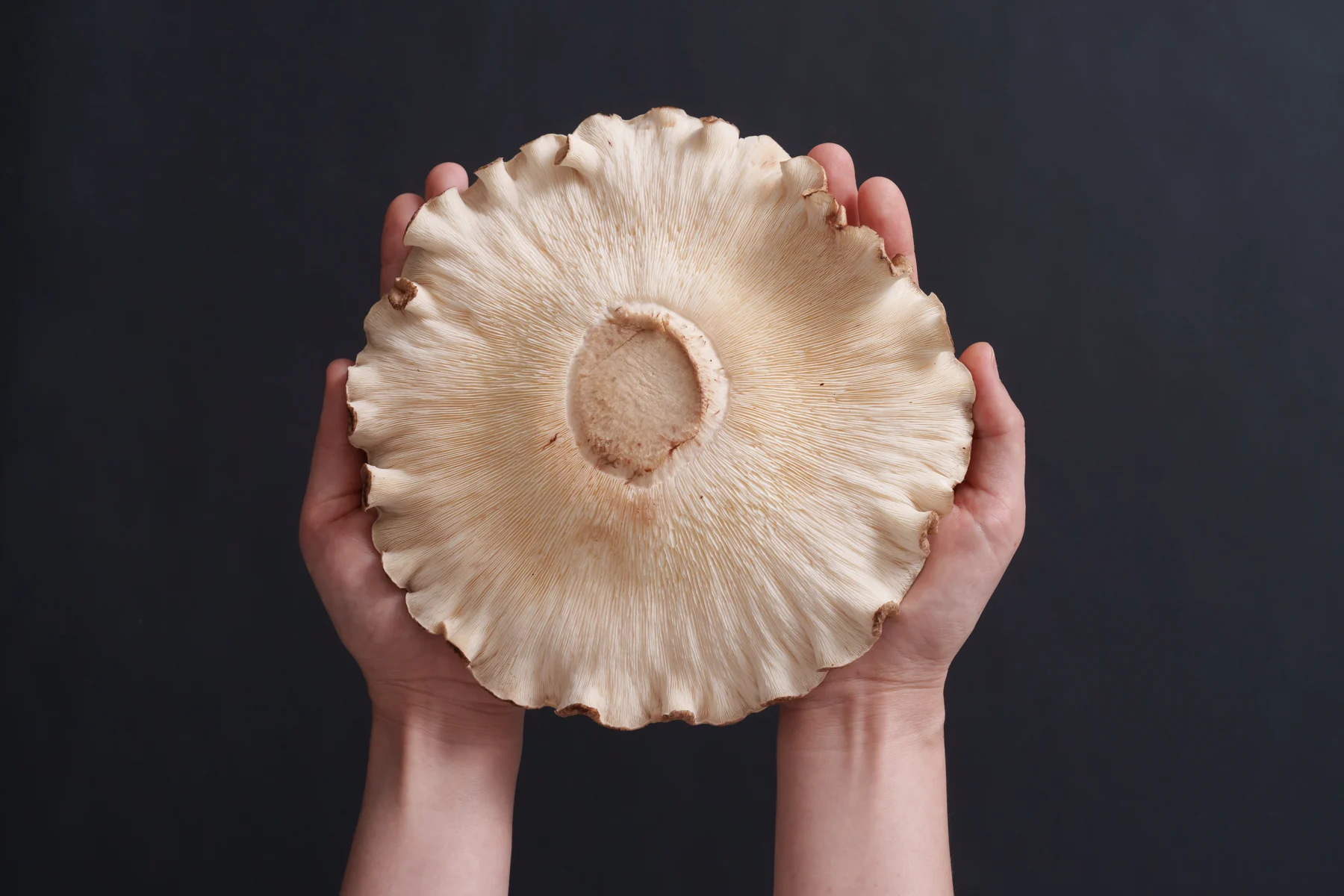
To answer the wish to make stuffed shiitake, it might have been enough simply to ship ones with slightly open caps. But since we were facing this realization, we wanted to make something more interesting, and so we decided to deliberately let the caps open as wide as possible.
That is how our "Daiban Shiitake" (大判しいたけ, large shiitake) was born. A reversal in thinking that came from listening to concrete uses at the dinner table has led to a new form of deliciousness.